Giving Up Driving: Supporting an Older Loved One Through the Change
When driving has to stop, rural life changes overnight. A guide for Monmouthshire families on the conversation, the rules and what comes next.
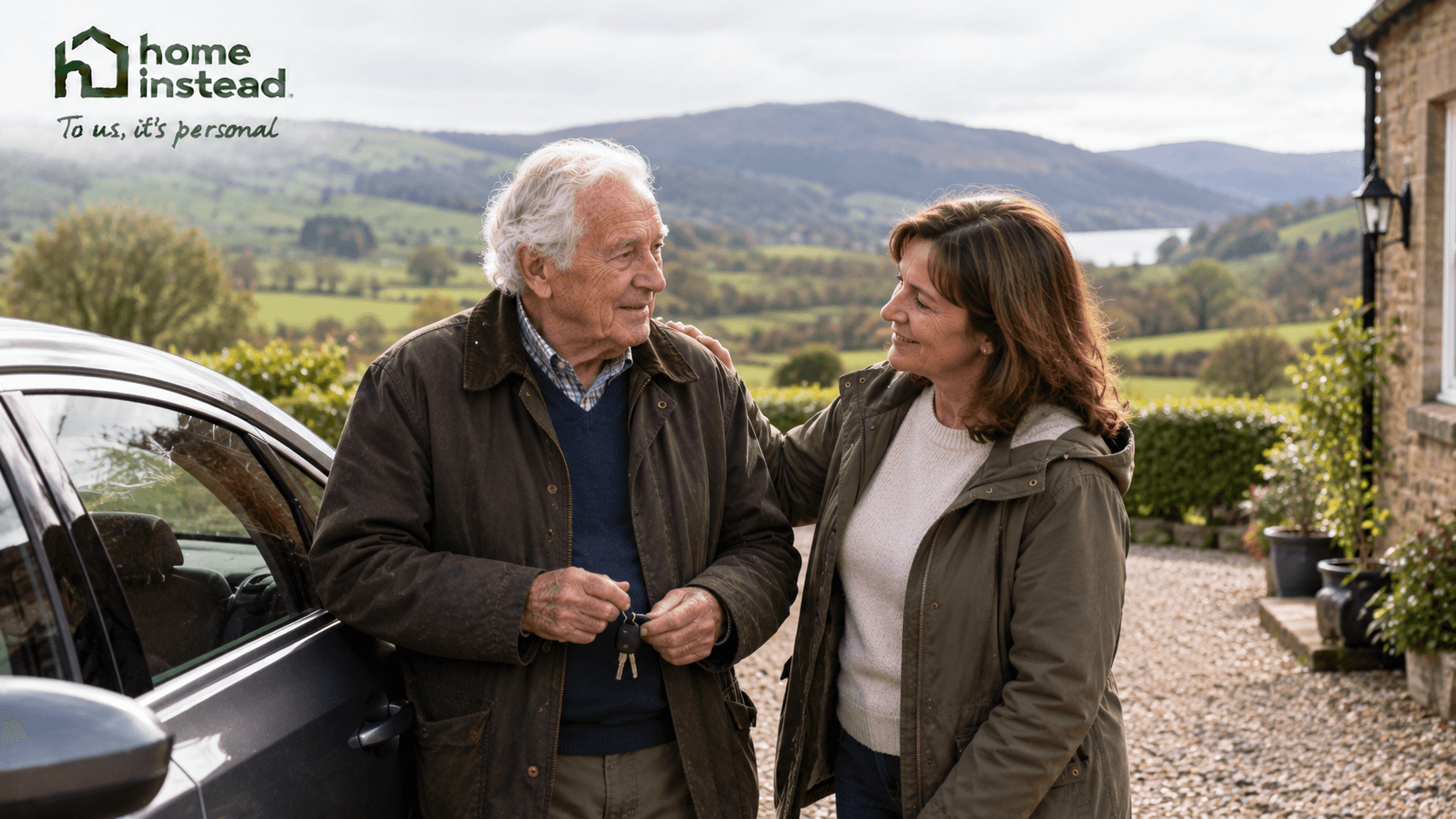
In a city, giving up the car is an inconvenience. In rural Monmouthshire it can be the single biggest change in someone’s later life. The car is how they get to the shop, the surgery, the chapel, the market, their friends. When it goes, all of that goes with it unless something replaces it.
That is why this conversation is so loaded, and why it so often goes badly. It is rarely really about driving. It is about independence, identity and the fear of being stuck.
What to look for
Age alone tells you nothing. Plenty of people drive safely well into their eighties and beyond. The things worth paying attention to:
- New dents and scrapes on the car, or on the gatepost
- Getting lost on familiar routes
- Drifting between lanes, or sitting very close to the wheel
- Slow or delayed reactions at junctions
- Other drivers sounding their horns more often
- Confusion between the accelerator and the brake
- Avoiding driving at night, in rain, or on faster roads often a sign they already know
- Passengers in the family quietly finding reasons not to travel with them
A single incident proves nothing. A pattern is worth acting on.
The legal position, briefly
There is no upper age limit for driving in the UK. What changes is that at 70 the licence must be renewed, and then every three years after that. Renewal is free and is largely a self-declaration about fitness to drive.
More importantly, there is a legal duty to tell the DVLA about certain medical conditions that could affect driving including a dementia diagnosis, certain eyesight conditions, epilepsy, some heart conditions and after a stroke. Failing to declare can invalidate insurance, which is a serious practical risk as well as a legal one.
A dementia diagnosis does not automatically mean driving must stop immediately. It does mean the DVLA must be told, and they will assess. Some people continue driving for a period with regular review. The GP can advise, and will raise concerns directly where they have them.
Having the conversation
A few approaches that tend to work better than a head-on confrontation:
- Start early, long before it is urgent a conversation at seventy-five about what the plan would be is far easier than one at eighty-four about what happens now.
- Ask rather than tell “how are you finding the driving these days, honestly?” Many people have private doubts they have never voiced.
- Be specific, not general “I noticed the scrape on the wing” lands better than “we are worried about your driving”.
- Talk about the alternative first the conversation is far easier when you arrive with a plan for how they will still get to everything, rather than just a request to stop.
- Consider a third party if it is becoming a family argument, the GP, an optician, or a driving assessment can take the heat out of it. Independent mobility assessment centres offer confidential assessments, which some people find far easier to accept than a judgement from a son or daughter.
- Offer a middle ground daytime only, local roads only, no motorway. For many people this is a far more acceptable first step than stopping altogether.
Our guide on how to raise a difficult subject with an older parent covers the broader approach, and much of it applies here.
When it cannot wait
Sometimes it is genuinely unsafe and the conversation has not worked. If someone is at real risk of harming themselves or others, you can contact the DVLA directly with your concerns, and their GP can also notify them. It is an unpleasant thing to do, and many families carry guilt about it for a long time afterwards. It is also sometimes the right thing to do.
What replaces the car
This is the part that decides whether giving up driving becomes a manageable change or the start of a decline. The honest difficulty in Monmouthshire is that bus services in the villages are limited and in some places barely exist.
Worth putting in place:
- A bus pass free travel for older people in Wales, which is worth having even if the service is sparse.
- Community transport schemes volunteer car schemes and dial-a-ride services operate across Monmouthshire. The council or a local community hub can point you to what runs in your area.
- Online shopping with delivery set up properly once, with a standing order of favourites, it removes the weekly worry entirely.
- Prescription delivery many pharmacies deliver locally. Worth asking.
- A standing arrangement with family a fixed day each week works better than ad hoc offers that are awkward to ask for.
- Regular companionship visits that include getting out a Care Professional who takes someone to the shops, the market or a coffee on a set day each week replaces much of what the car was really for.
The part that gets overlooked
Everyone focuses on logistics. The bigger risk is isolation. Someone who drove everywhere and now cannot is at real risk of simply staying in seeing fewer people, moving less, eating less well, and losing confidence quickly. The months after driving stops are a common turning point, and not usually a good one.
If a loved one has recently stopped driving, this is a good moment to look at what is keeping them connected. Our monthly Memory Cafés in Usk and Monmouth are open to anyone, and for people living rurally we can usually help with getting there. It is also worth keeping an eye on whether they are still eating well, since shopping and cooking often slip at the same time.
And allow it to be a loss
For a lot of people, particularly those who drove for a living or who have been driving for sixty years, this is genuinely a bereavement of sorts. It is the end of being able to go where they want, when they want, without asking anyone. Families sometimes rush past that because the practical problem feels more urgent. Acknowledging it saying out loud that it is a hard thing to give up tends to make everything that follows easier.
Related guides from our team
- Rural Home Care in Monmouthshire
- How to Talk to an Elderly Parent About Getting Help at Home
- Companionship Care in Monmouth, Abergavenny & Pontypool
- Memory Cafés, Seated Sports & Community Events in Monmouthshire
- Eating Well in Later Life
Talk to your local team
If a loved one in Monmouthshire has stopped driving, or is about to, and you are working out how they will manage, we would be glad to help you think it through. No pressure and no obligation.
Call our friendly team today on 01873 772772 or visit our website to arrange a free, no-obligation care consultation