Supporting Dementia Care at Home: Our Director Tony O'Flaherty Joins National Research Podcast
Our Director Tony O'Flaherty joins a national dementia research podcast, sharing real insights into compassionate home care. Listen & read more.
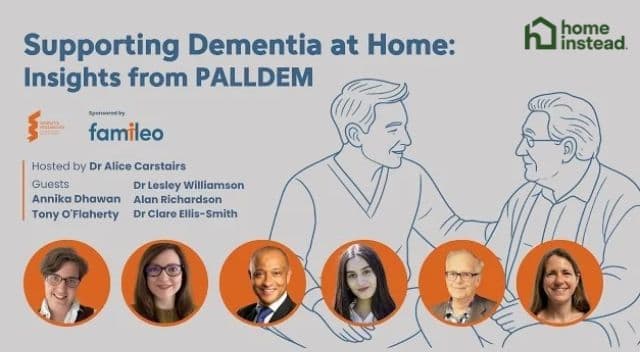
At Home Instead Wandsworth, Lambeth and Dulwich, dementia care isn’t just something we do. It’s something we’re deeply invested in improving, one relationship at a time. That’s why we’re proud to share that our Director, Tony O’Flaherty, recently joined a panel of leading researchers, clinicians, and lived-experience experts on the Dementia Researcher podcast, hosted by Dr Alice Carstairs of Alzheimer’s Society, to discuss a groundbreaking new study: PALLDEM Homecare.
The episode, “Supporting Dementia at Home: Insights from PALLDEM,” brought together some of the UK’s foremost voices in dementia research. Including Dr Lesley Williamson and Dr Clare Ellis-Smith from the Cicely Saunders Institute at King’s College London, research assistant Annika Dhawan, and lived-experience contributor Alan Richardson, who cared for his late mother for 15 years. Tony joined as the voice from inside a working home care service, bringing real-world insight into what dementia support actually looks like behind closed doors.
Why This Study Matters
Most people living with dementia in the UK are supported at home, and many will spend their final months there too. Yet, as the panel discussed, home care remains one of the least researched areas in the entire dementia care system, despite being where some of the most important, person-centred work happens every single day.
PALLDEM Homecare is a two-year research project funded by Alzheimer’s Society and Marie Curie, exploring how a tool called IPOS Dem (the Integrated Palliative Care Outcome Scale in Dementia) can be introduced into everyday home care. In simple terms, IPOS Dem helps carers systematically notice, record, and escalate changes in a client’s wellbeing — whether that’s discomfort, mobility changes, or shifts in mood — so the right support reaches the right person at the right time.
As one of the study’s collaborators, Tony brought a valuable perspective: what it actually takes to introduce a new tool into a busy home care service, and why any new system has to genuinely make life better for carers, not just add another form to fill in.
What a “Typical” Day of Dementia Care Actually Looks Like
One of the most valuable parts of the conversation was Tony describing what home care for dementia really involves and how little “typical” it can be. He shared examples from his own team’s experience, from a client who continued travelling abroad with his carer, to another who kept his love of long daily walks around Clapham Common. For a client who could no longer visit the opera, his carer simply sat and listened to opera music with him instead.
The message running through was simple: task-based care, medication, meals, and personal care are the baseline. What makes the real difference is helping people continue living as close as possible to the life they’ve always known.
Why Carers Deserve More Recognition
A recurring theme throughout the episode was just how under-recognised home care workers are, despite carrying enormous responsibility. Panellists spoke about the emotional and relational skill involved in the role — building trust with clients and families, noticing subtle changes day to day, and often being the first person to spot when something isn’t right.
Tony echoed this from an owner’s perspective, describing carers as people who consistently have their clients’ best interests at heart, and who deserve tools and training that genuinely support them, not just add pressure. He also touched on the role of the Care Quality Commission (CQC), explaining how tools like IPOS Dem can help home care providers demonstrate safe, effective, well-led care — giving families real peace of mind when choosing a provider for a loved one.
Our Commitment to Better Dementia Care
Being part of research like PALLDEM Homecare reflects something we believe strongly at Home Instead Wandsworth, Lambeth and Dulwich: that good dementia care is built on listening, learning, and continually striving to do better for the people we support.
We specialise in dementia care, and our carers receive dedicated training to help them provide compassionate, person-centred support, not just for tasks, but for the person as a whole. Contributing to national research like this helps us stay at the forefront of best practice, and ensures the voices of home care, often overlooked in the wider health and social care conversation, are properly heard.
Listen to the Full Episode
If you’d like to hear the full conversation, including more from Tony, Dr Lesley Williamson, Dr Clare Ellis-Smith, Annika Dhawan, and Alan Richardson, you can find the complete episode on the Dementia Researcher podcast, produced by University College London with funding from the National Institute for Health and Care Research (NIHR), Alzheimer’s Research UK, Alzheimer’s Society, Alzheimer’s Association, and Race Against Dementia.
Listen here: Dementia Researcher Podcast — Supporting Dementia at Home: Insights from PALLDEM
If you or a loved one are looking for compassionate, specialist dementia care at home, our team at Home Instead Wandsworth, Lambeth and Dulwich is here to help. Get in touch with us today to find out more about how we support people living with dementia to continue living life on their own terms.